
What is a Jam Nut
A jam nut is a low-profile fastener with reduced thickness compared to standard hex nuts, typically manufactured at approximately half the height of conventional nuts. The term “jam” refers to the nut’s primary function of being jammed or locked against another nut, component surface, or threaded shaft to prevent loosening and maintain assembly integrity.
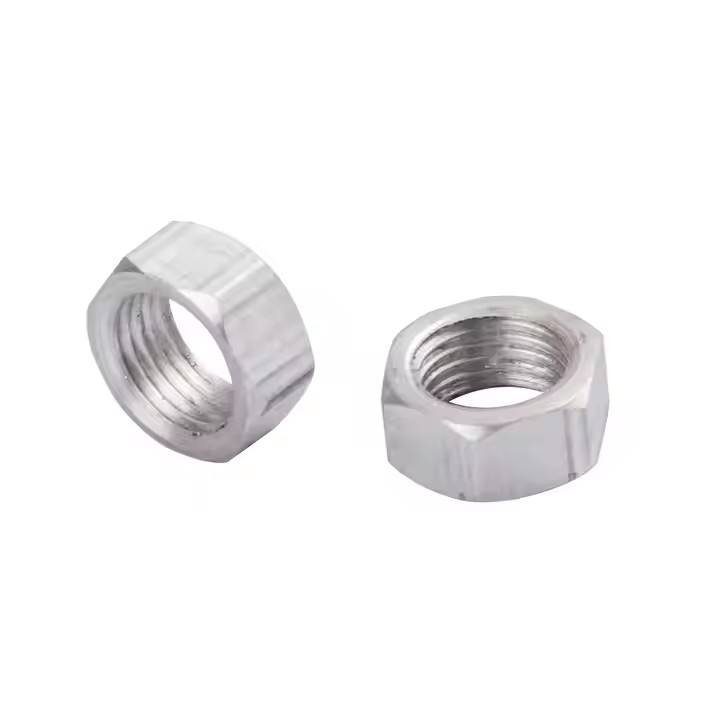
Jam nuts serve as both a locking mechanism and a space-saving fastener solution. Their slim profile allows installation in confined spaces where standard nuts cannot fit, while their dual-nut configuration provides reliable vibration resistance without specialized locking features.
Jam Nut Design and Specifications
Physical Characteristics
| Characteristic | Standard Nut | Jam Nut | Difference |
|---|---|---|---|
| Height | Full thickness | Approximately half | 40-60% reduction |
| Width across flats | Standard size | Same as standard | No difference |
| Thread specification | Full thread engagement | Full thread engagement | Identical |
| Weight | Standard | Significantly lighter | 40-50% reduction |
The jam nut maintains the same hex shape and width across flats as standard nuts, ensuring compatibility with standard wrench sizes. The reduced height provides the space-saving advantage while maintaining adequate thread engagement for secure fastening.
Material and Grade Options
| Material | Common Grades | Application |
|---|---|---|
| Steel | Grade 2, Grade 5, Grade 8 | General purpose, high-strength |
| Stainless steel | 18-8, 316 | Corrosion resistance |
| Brass | Commercial | Non-magnetic, electrical applications |
| Nylon insert | Grade A | Combined locking feature |
Jam nuts are manufactured from the same materials as standard nuts, with grade specifications matching the strength requirements of the application. The material selection depends on environmental conditions, strength requirements, and corrosion resistance needs.
How Jam Nuts Work
The Locking Mechanism
The jam nut functions through mechanical interference rather than friction-based locking. When a jam nut is tightened against a standard nut or against a shoulder or machined surface, it creates an opposing force that prevents the primary fastener from rotating loose.
Primary locking action:
- Thread friction: The jam nut creates additional thread surface area that resists rotation
- Shoulder contact: When seated against a shoulder or component surface, physical interference prevents movement
- Opposing torque: The relationship between the jam nut and primary nut creates opposing forces that cancel vibration-induced loosening tendencies
Installation Principles
The effectiveness of jam nut installation depends on proper technique. The jam nut must be seated firmly against the primary nut or component while maintaining adequate preload in the fastener assembly.
Proper installation sequence:
- Thread primary nut onto fastener to desired position
- Thread jam nut onto fastener with flat side facing primary nut
- Hold primary nut stationary with wrench
- Tighten jam nut against primary nut until seated firmly
- Verify both nuts are secure and will not rotate independently
Jam Nut Types and Variations
Standard Hex Jam Nut
The most common configuration features a standard hex shape with reduced height. This type is widely available and suitable for most applications requiring vibration-resistant fastening.
| Feature | Specification |
|---|---|
| Shape | Hexagonal |
| Height | Approximately 50% of standard nut |
| Surface | Plain or zinc-plated |
| Availability | Standard inventory item |
Flange Jam Nut
Flange jam nuts incorporate an integrated washer-like flange that provides additional bearing surface and centering capability. These are commonly used in automotive and machinery applications.
| Feature | Specification |
|---|---|
| Shape | Hex with integrated flange |
| Flange diameter | 1.5-2x nut width |
| Bearing surface | Distributed load |
| Application | Shaft centering, bearing preload |
Nylon Insert Jam Nut
Combining jam nut design with nylon insert locking technology provides dual-action security. The nylon insert engages the fastener threads while the jam nut configuration provides additional vibration resistance.
| Feature | Specification |
|---|---|
| Locking mechanism | Nylon insert + jam action |
| Reusability | Limited (nylon degrades) |
| Torque retention | Excellent |
| Application | Critical assemblies |
Acorn Jam Nut
Acorn jam nuts feature a domed top that encloses the threaded stud end, providing protection from injury and corrosion. These are commonly used in aesthetic applications and where exposed threads present safety concerns.
| Feature | Specification |
|---|---|
| Shape | Domed top, hex base |
| Thread protection | Complete enclosure |
| Application | Decorative, safety, marine |
Jam Nut vs Lock Nut: Comprehensive Comparison
Design Differences
| Aspect | Jam Nut | Lock Nut |
|---|---|---|
| Primary function | Position-locking through interference | Vibration-resistant through friction |
| Components required | Two nuts typically | Single nut |
| Reusability | Unlimited | Limited (depends on type) |
| Installation complexity | Higher (two wrenches needed) | Lower (single wrench) |
| Space requirement | More (stacked height) | Less (single nut) |
Performance Comparison
| Performance Factor | Jam Nut | Nylon Lock Nut | Split Lock Washer |
|---|---|---|---|
| Vibration resistance | Excellent | Good | Moderate |
| Temperature range | Wide | Limited (nylon degrades) | Wide |
| Reusability | Unlimited | Reduced after reuse | Limited |
| Axial play accommodation | Good | Limited | Moderate |
| Cost | Low | Moderate | Low |
Application Suitability
Choose jam nuts when:
- Vibration resistance is critical
- Assembly will be frequently disassembled
- Space allows for dual-nut installation
- Maximum reusability is required
- Lock nut would be over-engineered for the application
Choose lock nuts when:
- Space is severely restricted
- Single-wrench installation is preferred
- Permanent or semi-permanent installation
- Nylon locking is acceptable
Common Applications for Jam Nuts
Automotive Applications
| Application | Purpose |
|---|---|
| Suspension adjustments | Maintain ride height settings |
| Wheel bearing preload | Secure adjusters |
| Steering linkage | Prevent vibration loosening |
| Exhaust systems | Maintain gasket compression |
Industrial Machinery
| Application | Purpose |
|---|---|
| Shaft collars | Position locking |
| Bearing adjustment | Maintain preload settings |
| Motor mounts | Vibration resistance |
| Conveyor systems | Maintain belt tension |
Plumbing and Fluid Systems
| Application | Purpose |
|---|---|
| Pipe fittings | Vibration-resistant sealing |
| Valve adjustment | Maintain set points |
| Pump impeller clearance | Set and lock clearances |
Precision Equipment
| Application | Purpose |
|---|---|
| Optical mounting | Vibration isolation |
| Measurement equipment | Stable reference points |
| Audio equipment | Vibration damping |
Installation Best Practices
Preparation Steps
Before installing jam nuts, ensure the following:
- Thread condition: Verify threads are clean, undamaged, and properly formed
- Thread lubricant: Apply appropriate lubricant if required (consider torque implications)
- Wrench selection: Use correct wrench size for nut width
- Accessibility: Confirm adequate access for two-wrench operation
Tightening Procedure
Standard dual-nut installation:
- Thread the primary nut onto the fastener to the desired position
- Thread the jam nut onto the fastener until it contacts the primary nut
- Hold the primary nut stationary using appropriate wrench
- Tighten the jam nut against the primary nut using second wrench
- Verify neither nut rotates independently when tested
Shoulder-seated installation:
- Thread primary nut to final position
- Thread jam nut until it contacts the shoulder or component surface
- Tighten jam nut against the shoulder while holding primary nut
- The jam nut should be seated firmly, not just touching
Torque Specifications
| Nut Size | Standard Torque (Grade 8) | Jam Nut Consideration |
|---|---|---|
| 1/4-20 | 14 ft-lb | Same base torque, adjust for application |
| 5/16-18 | 29 ft-lb | Consider jam nut position effect |
| 3/8-16 | 45 ft-lb | Verify joint preload after jam nut seating |
| 1/2-13 | 75 ft-lb | Maintain consistent torque method |
Advantages and Disadvantages
Jam Nut Advantages
| Advantage | Description |
|---|---|
| Excellent vibration resistance | Opposing forces effectively counteract loosening |
| Unlimited reusability | Can be assembled and disassembled indefinitely |
| No special tools required | Uses standard wrenches |
| Adjustable | Position can be modified after installation |
| Cost-effective | Low cost per fastening point |
| Reliable | Mechanical principle, not dependent on features |
Jam Nut Disadvantages
| Disadvantage | Description |
|---|---|
| Two-wrench installation | Requires access and technique |
| Increased assembly height | Stacked configuration requires more space |
| Potential for incorrect installation | Must verify proper seating |
| Not suitable for all applications | Some joints incompatible |
| May require retightening | Initial settling may occur |
Troubleshooting Common Issues
Nut Rotation After Installation
| Cause | Solution |
|---|---|
| Insufficient jam nut torque | Retighten with proper torque |
| Thread damage | Inspect and replace damaged components |
| Inadequate primary nut preload | Reset assembly with appropriate preload |
| Wrong nut for application | Verify nut specifications match requirements |
Difficulty Seating Jam Nut
| Cause | Solution |
|---|---|
| Cross-threaded | Remove and restart thread engagement |
| Thread contamination | Clean threads thoroughly |
| Thread damage | Inspect and repair or replace fastener |
| Interference | Verify compatibility of mating threads |
Vibration Still Causing Loosening
| Cause | Solution |
|---|---|
| Insufficient initial preload | Redesign for adequate clamping force |
| Joint settling | Implement Belleville washers or other aids |
| Thermal cycling effects | Consider locking compound |
| Wrong application | Jam nuts may be insufficient for extreme conditions |
FAQ: Technical Clarifications
Q: What is a jam nut used for?
A: A jam nut is used to lock a primary nut in position on a threaded fastener, prevent loosening from vibration, adjust and secure precise positions on shafts or rods, and save space in applications where standard nuts cannot fit. The jam nut is tightened against the primary nut or a shoulder surface to create opposing forces that resist rotation and maintain assembly integrity.
Q: What is the difference between a jam nut and a lock nut?
A: A jam nut is a thin nut that locks a primary nut in position through mechanical interference, requiring two nuts in most applications and offering unlimited reusability. A lock nut incorporates built-in locking features such as nylon inserts, distorted threads, or prevailing-torque designs in a single nut. Lock nuts are easier to install but may have limited reusability and temperature range compared to jam nuts.
Q: How do you install a jam nut correctly?
A: Installation requires threading the primary nut onto the fastener first, then threading the jam nut with its flat side toward the primary nut. Hold the primary nut stationary with one wrench while tightening the jam nut against it with a second wrench. The jam nut should be seated firmly without excessive force—the goal is interference, not maximum torque. Verify neither nut rotates independently after installation.
Q: Which side of the jam nut faces the primary nut?
A: The flat side of the jam nut faces the primary nut in standard installation. The jam nut is designed to seat squarely against the primary nut or shoulder surface. Some applications may specify orientation differently based on specific joint requirements, but the flat-facing-primary configuration is the default for most applications.
Q: Can jam nuts be reused?
A: Yes, jam nuts can be reused indefinitely without degradation of locking capability, unlike nylon insert lock nuts which lose effectiveness after repeated installation. The mechanical interference principle of jam nuts does not degrade with use, making them ideal for applications requiring frequent assembly and disassembly.
Q: When should you use a jam nut instead of other locking methods?
A: Use jam nuts when the assembly will be frequently disassembled, when maximum reusability is required, when vibration resistance is critical, when other locking methods would be over-engineered for the application, and when space allows for dual-nut installation. Jam nuts are particularly effective for adjustable assemblies such as suspension components, bearing preload adjusters, and precision mounting systems.